The much publicized Apple iPhone 3.0 update was released around 1000 PDT yesterday.
I started my update as soon as I could and installed the latest version of the iPhone OS eagerly waiting to test out some of the new features. All very well and good.
Today, my two killer iPhone Apps, OmniFocus and Evernote both got upgraded to take advantage of the iPhone 3.0 features.
OmniFocus
OmniFocus version 1.5 for the iPhone has been released.
The main feature in this upgrade include integration of cut, copy, and paste features as well as utilizing the integrated maps.
These improvements include better synchronization, no “Pending” Tab, Instant Groups, Advanced Searching, Way Better Audio, Landscape View and many bug fixes.
The great guys over at Evernote have made a nice little video of the latest features of 3.0.
This is a great time to own an iPhone if you are into productivity!
I am writing this post on Saturday as I am taking my wife away tomorrow for our wedding anniversary which is on Monday the 15th of June. We are staying in a nice hotel and spa to celebrate our 13 years of marriage!
I started to clear out my office and I am dedicating more time to it next week. I want to get it decorated in the next week so that I can start to plan the layout and get the new office furniture ordered. I am really looking forward to improving my home office.
My second link is a link to a little post and video about how to Get More Organized with Evernote. I love Evernote and I am looking forward to getting my new scanner and going totally paperless using Evernote!
My third link is a link to a great post titled Three Quick Tips for Getting Ahead in Life. All three tips are simple but very thought provoking and I am sure that you, as I can take something from these three tips.
My fourth link is a link to a post about Making OmniFocus look good with themes. I have mentioned before that I love the functionality of OmniFocus but the visual appeal of Things and The Hit List do draw me to their apps. This post shows you how you can make OmniFocus look much better by applying themes.
My fifth and last link is a link to a post about GTD.NET, which is a Microsoft .NET GTD Application for Windows desktop clients as well as Windows Mobile Devices. Not one for me but looks great for Windows users. I will download it to one of my Windows VMs to check it out.
I am happy to say that I am eventually upgrading my home office and this is something I am really looking forward to.
My current office layout is now nearly 8 years old and a lot has changed since then. Time for a change and time for me to start with a blank canvas and plan an ideal and productive home office.
My home office 9 foot x 7 foot, so a pretty good size for just me and all the techie gadgets I can fit into it!
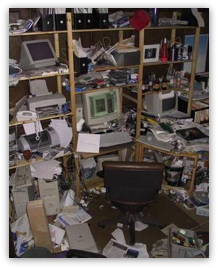
I am trying to get quite a minimal layout within my office whilst building a great working environment. My current office is rather cluttered and does become a dumping ground for a lot of things.
So, the essentials I need as far as I can see are a chair, desk, filing cabinet, inbox trays, and some cabinet to hold my printer.
I am totally clearing my office and buying everything new. I am going to take down my wall units and get the office painted and new carpet.
I currently have a desk with two drawers down each side. One is a drawer and filing cabinet and the other is three drawers. The filing cabinet is bad as it is hard to get my files in and out due to the layout of the drawer and the fact that it does not fully open. I currently have quite a cheap fake leather chair. My printer is on the top of a nice Ikea wooden cupboard.
For my new office I want a big, curved desk to hold my MacBook Pro and 30″ Monitor. I have seen one in Ikea from the Galant range. I want to do away with pedestal drawers as I just seem to fill these with junk, as most drawers are in most offices.
I am looking for a nice premium but trendy chair. Not really started looking but one in Costco does take my eye although it is quite expensive at £250.
I currently do not have a great filing capability and I must have a good filing cabinet in my new office. I want at least two drawers with the ability to utilize my manila folders and A to Z system.
I do not implement the Tickler File so no need for the 43 folders!
I have a laser printer that I do use quite a lot when I need to print anything out. It is only a small footprint but I still need some cabinet to keep it in, ideally out of view.
I am also really fancying a scanner to go totally paperless. I currently have a HP OfficeJet All In One but this has a large footprint and takes an absolute age to scan from.
I therefore will purchase a Fujitsu ScanSnap. The models I am looking at are the S300M or the S510M. These are not cheap scanners but the ability to duplex scan as well as use the ability to load the document tray with up to 20 sheets makes these a very attractive proposition.
I love Evernote and the ability to scan from the ScanSnap scanners straight to Evernote looks amazing, and one of my main drivers for trying a totally paperless office.
If I implement a paperless office I am going to need a good shredder. I currently have a bin shredder but it is quite lightweight so I may look at the cost of updating to something more heavy duty as I plan to shred everything I can.
I will take photos and keep you all updated of my new workspace.
Also, the photo at the top of this post is NOT my current home office 🙂
I would love to hear any recommendations anybody has about building the ideal home office or the choice of equipment to place in the office to make it as productive as possible.
It has been my twins birthdays today. They are three. How time flies!
Had a good day at a toddler theme park in the UK. Got wet, as usual, but had a great time.
Here are my collection of links for this week.
My first link for this week is a link to a great SlideShare presentation on Time Management for Getting More Done with Getting Things Done. Intriguing title and well worth a look. I feel a post about SlideShare coming as some awesome resources are now on SlideShare.
My second link is a link to a list of 5 Great GTD Applications for Linux. It is probably fair to say that pure Linux users are in their minority but they do still exist. I know from this blog stats that I have many followers who are Linux based so this list of Linux GTD apps will be well received.
My fifth and last link is a link to a post that raised quite a lot of interest when I tweeted about it. The post is Why GTD Sucks from Darkling Wood. Interesting post that I do not fully agree with. I am not the type of person who pushes pure GTD down peoples throats but I do believe in improvement and having the willingness to develop. What I love about GTD is the loose methodology that can bring so much to people. Love to hear your thought son this post.
I promise you all that I will write a couple more posts this week as I have some good ideas for the week.
I have eventually got around to taking a better look at the Mac GTD app, Things, and adding to a review that I did a while ago.
I currently use OmniFocus but Things and The Hit List are grabbing my attention. Anyway, here is my review and thoughts about Things.
Things is a blandly named but ultimately excellent organizational application designed for use through a variety of mediums.
The visual approach taken by Things is simple enough to keep everything easily accessible while still maintaining an impressive level of flare. Designers have given the software a certain level of sheen although the layout will look immediately familiar to users who are accustomed to the aesthetic of Mac-developed programs.
The most useful features are well-labeled and located in a well-organized and convenient manner. Icons are all colorful and easy to locate as well and this is something which helps in navigating them against the otherwise grey and white interface.
The program provides users with a solid level of productivity access through a great list of truly useful features. Among the laundry list of options are GTD staple categories such as Today, Next, Someday and Postpone sorting categories with appropriate sub-lists available within each parent grouping.
Perhaps most useful is an included HUD option, something which is a truly fantastic feature and allows for quick, no-nonsense inputting of any upcoming task on the user’s mind.
Things also does a great job of keeping the main window clutter-free by way of a feature which removes columns and instead opts to display only relevant information for upcoming tasks.
Mobile access is set up and ready to go through a few different platforms including the ever popular support for both the iPhone and iPod Touch Apps. While it seems that smartphone access may initially be limited to the two aforementioned devices Things does do a little bit to extend remote usage by programming a built-in collaboration feature which promises to link any user’s work with any desired colleague.
As of now an exhaustive wiki accompanies a regular blog and burgeoning forum to provide quite a bit of promise for those users who hope to find other Things devotees to discuss the program with. If this element of the project is kept up with then it would seem that peer support and company interaction won’t be an issue upon release.
Things is impressive with a clean interface, excellent user support and great list of features could make Things one of the few productivity programs worthy of plunking down any real money for. It’s definitely worth the time necessary to check out to decide for yourself.
I am sticking with OmniFocus for now. But Things has officially got my attention!
Well, over to you, my readers. How many of you use Things and how many use OmniFocus or another app to get things done?
Had another great but very busy week. I was in the Forest of Dean for two days this week and then took a long weekend to go camping with my family on the East coast of the UK.
We stayed in a traditional North American Tipi and had a great time. The weather was very kind to use, which is always a bonus in the UK!
My second link is a link to a comparison of Getting Things Done (GTD) vs. First Things First (FTF). FTF is a mthodology from Steven Covey that differs to the GTD Methodlogy from David Allen in quite a few ways. Good post that is worth a read.
My third link is a link to the final post in the Best and Worse series from GTD Coach Kelly Forrister. This series of posts from Kelly has been about the best and worst practices for the five main areas of the GTD Methodology. This is invaluable reading if you are an advocate of Getting Things Done.
My fourth link is a link to a neat little GTD trick – Using a calendar as a file index to find files. The source of this trick is the author of the Japanese book, Idea Hacks, take a look.
My fifth and last link is a link to a GTD Community on Ning.com. Worth a look as there are some good resources on the community website.
I have still got quite a lot to do before my work week starts tomorrow so I will leave you all here.
Had a great day out today with my family. Sun was shining and it was great to spend some quality time with my wife and children.
I have had another productive week. All my project work was completed on time and my trip to Dover was a great success. Next week I am at the Forest of Dean which is an area I have never been to so I am looking forward to that.
Here are my collection of links for this week.
My first link for this week is a link to a collection of 55 ways to boost productivity from the productivity pro blog. This is a great list that may just get your thought patterns buzzing!
My second link is a link to a review of how somebody handles the dreaded GTD review. We all know that the weekly review is quite hard to stick to and even David Allen, the creator of the GTD Methodology states that this is the biggest problem people seem to have. So, nice to read how somebody is getting their reviews done.
My third link is a link to the 10 Ways to Get Started in GTD from the great GTD Blog GTD Times. I have introduced a lot of people to the GTD methodology so this list is great to point new or inquisitive people to.
My fourth link is a link to an offbeat post titled 5 Productivity Tips from the Stand-Up Comedy World. I always love these posts that take lessons from one discipline and relate them to something new. Interesting stuff.
My fifth and last link is a link to a nice little post explaining GTD and Productivity with Gmail. The author uses the fantastic GTDInbox for implementing GTD within GMail and then he goes on to explain how he has set his system up. Good reading!
I have been a massive fan of Zig Ziglar since hearing one of his CDs by chance a good 10 years ago.
The Ziglar Corporation are a training and development company that have really embraced the Internet and Social Media. The company is now headed by Zig’s Son, Tom Ziglar.
They have a great blog and do some really good Video Podcasts that are available from iTunes.
Below is a short video with Tom and his Father Zig where they talk about Twitter and the benefit it has brought to the Ziglar Corporation.
I do wish the Mac version had some of the cool functionality of the Windows version but still, the main aspect of being able to create awesome Mind Maps is there in the Mac version.
In my opinion, MindJet have really raised their game, especially since Michael Deutch (a regular reader of this blog) has joined the team and started writing for the blog.
I recently received an email from MindJet that provided a summary of some of their recent productivity and GTD activity via their blog and website. It is that good that I decided to repeat some of these great links here for the benefit of my blog readers.
So, here is the list of MindJet links to check out:
I am a MindJet affiliate and do make money if you follow my links and buy MindManager. I love this tool and have been using and promoting it a long time before they launched an affiliate program!
As always, I would love to hear any other tips, tricks, or links you have regarding GTD and Mind Mapping!
Oh, and if somebody from MindJet reads this, get a move on with an iPhone application as I would really love to see MindManager on the Apple iPhone!
I have just driven 270 miles to Dover, the closest part of the UK to France. I am down here for a few days with work.
The journey was not that bad. Remembered to pack my iPod and my FM Transmitter so I listened to a couple of podcasts that really made the journey shorter. I started with the latest MacBreak Weekly with Leo Laporte. This one covered some of the rumors about the new iPhone 3.0 and maybe(hopefully) a new version of the iPhone.
I then listened to the Net@Night show also from Leo Laporte and also Amber McArthur. The show I listened to was titled Evernote and contained an interview with Phil Libin, the Evernote CEO. Great listening, enjoyed it.
I then spent the last 90 minutes or so listening to How to be a Winner by Zig Ziglar. Great CD that I have listened to many times.
So, all in all quite a productive 4 hours 30 minutes in the car. Now I need food!
My second link is a link to the author profile of Zig Ziglar. If you have not yet listened to Zig, make sure you check him out. I have some great video’s of Zig in action that I am going to post this week.
My third link is a link to the 100 Best iPhone Apps for Serious Self Learners. There are just so many cool iPhone apps that it is now impossible to keep uo with them all. This little post outlines 100 great apps for self learners.
My fourth link is a link from Thinksimplenow.com introducing the 4 Hour Workday. I presume you have heard of the 4 Hour Workweek, well take a look at this post that outlines a 4 hour workday. Sounds nice doesn’t it!
My fifth and last link is a link to a great little post entitled How to Live Life. I love little focus generating posts like this that help you to get back on track and remember what is important in life.
Well, hopefully my room service order will be here soon so I will leave you here.

 I am happy to say that I am eventually upgrading my home office and this is something I am really looking forward to.